If perimenopause symptoms are disrupting your sleep, your mood, or your ability to function at work, and you’ve ruled out other medical causes, it’s worth talking to a provider about hormone replacement therapy. That’s the short answer. But most women searching this question want more than a one liner. They want a practical way to evaluate whether HRT actually makes sense for their body, their symptoms, and their stage of life. This guide walks through the signs, the decision factors, and what happens when you sit down with a provider to have that conversation.
Signs That Perimenopause Is Affecting Your Quality of Life
Perimenopause typically begins in your mid to late 40s, though some women notice changes as early as their late 30s. The transition lasts about four years on average but can stretch well beyond a decade. During this time, estrogen and progesterone levels fluctuate unpredictably, which is why symptoms can feel so random and hard to pin down.
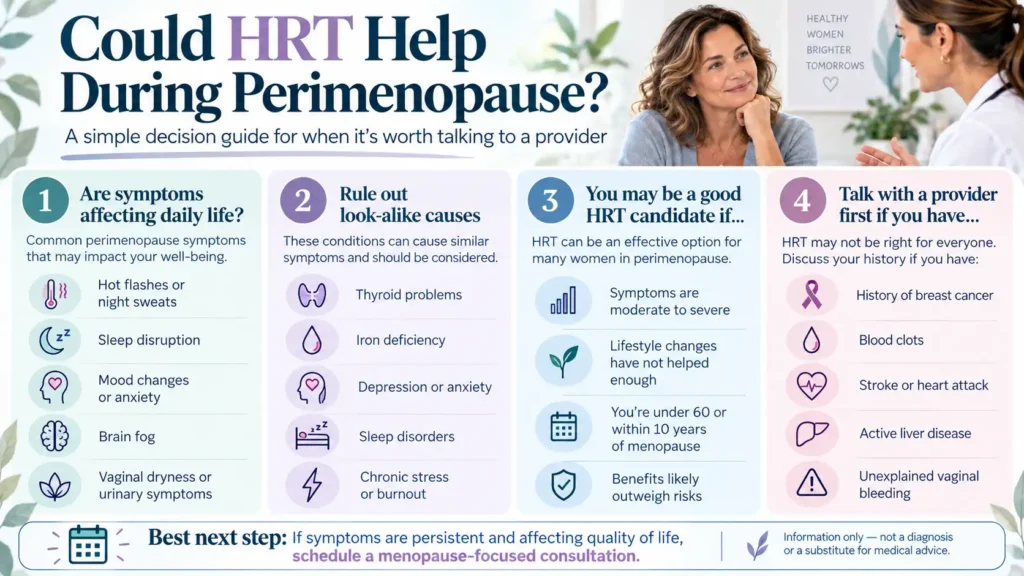
The symptoms that most often push women toward considering HRT include:
Hot flashes and night sweats that wake you up multiple times a night or make it difficult to get through meetings, social events, or daily tasks. About 80% of women in perimenopause experience vasomotor symptoms, and for many, they’re severe enough to affect work performance and relationships.
Sleep disruption that goes beyond the occasional restless night. Waking up drenched in sweat at 3 a.m. and then lying there unable to fall back asleep, night after night, takes a real toll. Poor sleep compounds every other symptom on this list.
Mood changes including anxiety that feels new or unfamiliar, irritability that’s out of proportion to the situation, or depressive episodes. Research shows women are two to four times more likely to experience major depression during or just after the perimenopausal transition.
Brain fog and memory lapses that affect your ability to concentrate, recall words, or stay on task. Many women describe feeling like they’ve “lost” their sharpness and worry something more serious is going on.
Vaginal dryness, painful sex, and urinary symptoms including urgency, frequency, or recurrent UTIs. These are caused by declining estrogen’s effect on vaginal and urinary tissue, and they tend to worsen over time without treatment.
Joint pain, muscle stiffness, and bone density concerns. Estrogen plays a protective role in bone health, and its decline accelerates bone loss. Women can lose up to 20% of their bone density in the first five to seven years after menopause.
Hair thinning or changes in hair texture that can feel alarming, especially when other explanations have been ruled out.
The key question isn’t whether you have these symptoms. It’s whether they’re persistent, severe enough to interfere with your daily life, and not improving with basic lifestyle changes like better sleep habits, exercise, or stress management.
Is It Perimenopause or Something Else?
This is one of the most overlooked questions in the entire conversation around HRT, and almost no one online addresses it properly.
Perimenopause symptoms overlap significantly with several other conditions. Before assuming you need hormone therapy, it’s important to rule out or identify:
Thyroid disorders. An underactive or overactive thyroid can cause fatigue, mood swings, weight changes, irregular periods, brain fog, and sleep problems. A simple TSH blood test can screen for thyroid dysfunction, and treatment is straightforward. Lumē Wellness offers thyroid optimization alongside hormone therapy because the two conditions frequently overlap and treating only one while missing the other leaves women feeling stuck.
Iron deficiency anemia. Low iron causes fatigue, brain fog, dizziness, heart palpitations, and poor concentration. These symptoms mirror perimenopause closely, and women with heavy perimenopausal bleeding are at higher risk for iron depletion.
Depression and anxiety disorders. While hormonal shifts can trigger mood changes, clinical depression and generalized anxiety exist independently and require different treatment approaches. If mood symptoms are persistent, severe, or accompanied by feelings of hopelessness, a mental health evaluation matters.
Sleep disorders. Obstructive sleep apnea is underdiagnosed in women, especially during midlife. If you snore, wake up gasping, or feel exhausted despite adequate hours in bed, a sleep study may be more useful than hormone therapy.
Chronic stress and burnout. Prolonged stress mimics many perimenopause symptoms, including fatigue, brain fog, sleep disruption, and mood instability. Addressing the root cause matters before adding medications.
A thorough provider won’t hand you a prescription based on symptoms alone. They’ll work through this differential to make sure treatment matches the actual problem.
What Makes Someone a Good Candidate for HRT
According to the North American Menopause Society’s 2022 position statement, the best candidates for hormone therapy are healthy women under 60 who are within 10 years of menopause onset, and whose benefits clearly outweigh their individual risks.
This is what’s known as the “Window of Opportunity.” Data from the Women’s Health Initiative reanalysis shows that women who start HRT within 10 years of menopause onset have a lower risk of coronary heart disease and reduced all cause mortality compared to women who start later or not at all. In the 50 to 59 age group specifically, mortality dropped by 30%.
Here’s a practical framework for evaluating whether you’re a good candidate:
You’re likely a good candidate if:
- Your symptoms are moderate to severe and affecting your quality of life
- You’re under 60 or within 10 years of your final menstrual period
- You’ve ruled out other conditions that mimic perimenopause
- You don’t have any absolute contraindications (listed below)
- Lifestyle interventions alone haven’t provided adequate relief
- You’re experiencing early menopause (before age 45) or premature ovarian insufficiency
It’s especially worth considering if your symptoms have persisted for more than six months and haven’t responded to other approaches.
A significant update worth noting: in February 2026, the FDA removed its boxed warnings for cardiovascular disease, breast cancer, and probable dementia from six HRT products. This reflects the evolving evidence that when hormone therapy is started at the right time, the benefits for most women outweigh the risks.
Who Should Avoid HRT
HRT isn’t appropriate for everyone. Absolute contraindications include:
- A history of breast cancer or other estrogen sensitive cancers
- A history of blood clots (DVT or pulmonary embolism) or inherited clotting disorders
- Active or recent cardiovascular events (heart attack, stroke)
- Uncontrolled high blood pressure
- Active liver disease
- Unexplained vaginal bleeding (this needs evaluation before any hormonal treatment)
Relative contraindications, where the decision requires careful evaluation with your provider, include migraine with aura, severe obesity, metabolic syndrome, gallbladder disease, and a strong family history of breast cancer.
If you fall into one of these categories, HRT may still be possible in certain forms or doses, or a non hormonal option may be a better fit. The point is that these conversations require individualized assessment, not a blanket yes or no.
Bioidentical vs. Conventional HRT: What You Should Know
There’s a lot of confusion around this topic, so let’s clear it up.
“Bioidentical” means the hormones are chemically identical to what your body naturally produces. What many women don’t realize is that FDA approved bioidentical hormones already exist. Estradiol patches, gels, and sprays are bioidentical. Oral and vaginal micronized progesterone is bioidentical. These products are regulated, tested, and standardized for consistent dosing.
Compounded bioidentical hormones, on the other hand, are custom mixed by compounding pharmacies. The North American Menopause Society has flagged concerns about compounded formulations because they lack standardized testing, may have inconsistent potency, and don’t carry the same safety data as FDA approved products. Pellet implants specifically can produce hormone levels far above the normal range and are difficult to remove if problems arise.
The takeaway: “bioidentical” isn’t a synonym for “compounded” or “natural.” FDA approved bioidentical options give you structurally identical hormones with the quality controls of pharmaceutical manufacturing.
One critical safety note that most online resources gloss over: if you have a uterus, you must take a progestogen alongside estrogen. Estrogen alone dramatically increases the risk of endometrial hyperplasia. In clinical trials, unopposed estrogen raised that risk 37 fold. This isn’t optional, and any provider who prescribes estrogen without discussing progestogen protection should raise a red flag.
What to Expect at Your First HRT Consultation
Walking into an appointment feels less intimidating when you know what’s coming. A thorough first consultation typically includes:
A detailed medical and family history covering cardiovascular disease, cancer (especially breast), blood clots, liver problems, and autoimmune conditions. Your provider also needs to understand your current medications, supplements, and lifestyle.
A symptom review to assess what you’re experiencing, how long it’s been going on, and how it’s affecting your daily life.
Laboratory testing including estrogen, progesterone, testosterone, thyroid hormones, and sometimes adrenal markers. While hormone levels fluctuate during perimenopause and a single lab draw isn’t diagnostic on its own, these results help paint a fuller picture alongside your symptoms and history.
A physical examination including vitals and, depending on the practice, a targeted reproductive health assessment.
A collaborative treatment discussion. Your provider should walk you through the options (oral, transdermal patch, topical gel), explain the reasoning behind their recommendation, and factor in your preferences. Treatment is not one size fits all.
At Lumē Wellness in Peoria, AZ, follow up appointments happen every three to six months to monitor how you’re responding, adjust dosing if needed, and recheck labs. Most women start noticing improvement within a few weeks, with full effects typically developing over about three months. If you’re curious about what the timeline looks like for specific symptoms, that varies by individual.
What If HRT Isn’t Right for You?
If you have contraindications to hormone therapy or simply prefer not to use it, there are evidence based alternatives.
Fezolinetant (Veozah), FDA approved in May 2023, reduces hot flash frequency by roughly 60%. It works through a completely different mechanism than hormones, targeting neurokinin B receptors in the brain. Elinzanetant (Lynkuet), FDA approved in October 2025, showed a 73.8% reduction in moderate to severe hot flashes at 12 weeks in clinical trials.
Cognitive behavioral therapy (CBT) has strong evidence for improving sleep, reducing the impact of hot flashes, and managing mood and anxiety during perimenopause.
SSRIs and SNRIs can help with mood symptoms and have a modest effect on hot flashes, though they’re not first line treatments for vasomotor symptoms specifically.
Vaginal moisturizers and low dose vaginal estrogen can address dryness and urinary symptoms locally, with minimal systemic absorption. Even women who can’t take systemic HRT can often use vaginal estrogen safely.
Lifestyle factors also matter. Regular weight bearing exercise supports bone density. Stress management techniques improve sleep and mood. Limiting alcohol and caffeine can reduce hot flash triggers. These aren’t replacements for medical treatment when symptoms are severe, but they’re meaningful complements to any approach.
FAQs
How do I know if my symptoms are perimenopause or just stress?
Perimenopause typically involves changes to your menstrual cycle (shorter or longer cycles, heavier or lighter bleeding, skipped periods) alongside symptoms like hot flashes, night sweats, and vaginal dryness. Stress alone doesn’t usually cause cycle changes or vasomotor symptoms. If you’re unsure, your provider can evaluate symptoms and run basic labs to help clarify.
Can you test for perimenopause with a blood test?
Not reliably. Hormone levels fluctuate significantly during perimenopause, so a single FSH or estradiol test can come back “normal” one week and abnormal the next. Perimenopause is diagnosed clinically, based on your symptoms, age, and menstrual cycle changes, not a lab result.
Is it better to start HRT during perimenopause or wait until menopause?
Starting during perimenopause or early menopause is generally considered safer and more beneficial than waiting. The Window of Opportunity research shows that initiating HRT within 10 years of menopause onset and before age 60 is associated with the best outcomes, including reduced cardiovascular risk and lower all cause mortality.
How long do you stay on HRT?
There’s no fixed timeline. The North American Menopause Society states that HRT doesn’t need to be routinely discontinued at age 60 or 65. Duration depends on your ongoing symptoms, risk factors, and response to treatment. Your provider should reassess periodically to confirm the benefits still outweigh the risks for your situation.
Does HRT cause weight gain?
HRT does not cause weight gain. In fact, some research suggests it may help with the redistribution of body fat that occurs during menopause, particularly the shift toward abdominal fat storage. Weight changes during perimenopause are more closely linked to aging, metabolic shifts, and lifestyle factors than to hormone therapy itself.
What’s the difference between bioidentical and synthetic hormones?
Bioidentical hormones are chemically identical to the estrogen and progesterone your body produces. Many FDA approved HRT products are already bioidentical, including estradiol patches and micronized progesterone capsules. “Synthetic” typically refers to older formulations like conjugated equine estrogens or medroxyprogesterone acetate, which have a different chemical structure. Both types can be effective, but bioidentical options are increasingly preferred due to their favorable safety profiles.
Ready to find out if HRT is right for you? Schedule a consultation at Lumē Wellness. Our providers take the time to evaluate your full health picture, including hormone levels, thyroid function, and lifestyle factors, so your treatment plan is built around you.