
Most men searching for information about testosterone replacement therapy are not looking for a biology lecture. They want to know what actually happens inside their body when they start treatment, how long it takes before they feel different, and whether the whole thing is safe.
Those are fair questions. And the answers are more nuanced than what you will find on most websites that either oversimplify the process or bury you in medical jargon you did not ask for.
This guide covers the real mechanism behind TRT, the research that defines realistic timelines, and what functional medicine providers like our team at Lume Wellness look at that most clinics skip entirely.
What Testosterone Actually Does in Your Body
Before you can understand how TRT works, you need a basic picture of what testosterone is doing when everything is running normally.
Testosterone is a hormone. That word gets thrown around casually, but hormones are chemical messengers that tell your cells what to do. Testosterone specifically tells certain cells to build muscle protein, maintain bone density, produce red blood cells, regulate fat distribution, and support the brain chemistry involved in mood, motivation, and sex drive.
Your body produces testosterone primarily in the testes. A smaller amount comes from the adrenal glands. The whole system runs on a feedback loop controlled by your brain, specifically the hypothalamus and pituitary gland. This loop is called the hypothalamic pituitary gonadal axis, or HPG axis, and understanding it matters because TRT directly affects how this system operates.
Here is how the loop works when everything is functioning properly. Your hypothalamus releases a hormone called GnRH (gonadotropin releasing hormone) in pulses. Those pulses signal the pituitary gland to release two more hormones: LH (luteinizing hormone) and FSH (follicle stimulating hormone). LH travels to the Leydig cells in your testes and tells them to produce testosterone. FSH supports sperm production. When testosterone levels in your blood reach a certain threshold, the hypothalamus detects this and dials back GnRH production. Less GnRH means less LH, which means less testosterone production. The system self regulates.
This is elegant when it works. The problem is that it stops working properly for a lot of men.
Why Testosterone Levels Drop
Testosterone production peaks in most men during their late teens and early twenties. After about age 30, levels decline at roughly 1% to 2% per year. That is gradual enough that many men do not notice anything in their thirties. By their forties or fifties, the cumulative decline can become significant.
But age is not the only factor. The men we see at our functional medicine clinic often have additional issues compounding the decline. Chronic stress raises cortisol, which directly suppresses GnRH and the entire HPG axis. Poor sleep disrupts testosterone production because the majority of daily testosterone release happens during deep sleep. Excess body fat converts testosterone into estrogen through an enzyme called aromatase, creating a feedback loop where low testosterone promotes fat gain, and fat gain further lowers testosterone. Insulin resistance, which is increasingly common, also disrupts normal hormone signaling.
Some men have a condition called hypogonadism, where the testes or the pituitary gland are simply not producing adequate hormones regardless of lifestyle factors. This can be primary (a problem with the testes themselves) or secondary (a problem with the signals from the brain). Blood work tells us which type we are dealing with, and that distinction shapes the treatment approach.
The point is that low testosterone is not just “getting older.” It is a measurable hormonal deficiency with identifiable causes, and TRT is one of the tools for addressing it.
How Testosterone Replacement Therapy Works: The Mechanism
TRT is straightforward in concept. Your body is not producing enough testosterone on its own, so you provide it externally. But what happens at the cellular level is worth understanding because it explains why the treatment works the way it does and why some effects show up faster than others.
When you receive testosterone through any delivery method, the hormone enters your bloodstream. From there, it circulates throughout your body. Most of this testosterone binds to a protein called sex hormone binding globulin (SHBG) or to albumin. Only about 2% to 3% remains unbound, or “free,” and this free testosterone is the fraction that actively enters your cells and produces effects.
Once free testosterone reaches a target cell, it passes through the cell membrane and binds to an androgen receptor inside the cell. This testosterone receptor complex then moves into the cell nucleus, where it attaches to specific regions of DNA and activates gene transcription. The cell starts producing the proteins that testosterone told it to make. In a muscle cell, that means structural proteins that increase muscle fiber size. In a bone cell, it means proteins that strengthen bone matrix. In the brain, it means neurotransmitters that affect mood, energy, and cognitive function.
This is what researchers call the genomic pathway, and it is the reason why many of testosterone’s effects on muscle and bone take months to become apparent. Building new protein takes time.
There is also a non genomic pathway that works much faster. Some testosterone effects occur within minutes to hours because they happen through direct interaction with cell membrane receptors rather than through gene transcription. This pathway is responsible for the relatively quick changes some men notice in mood, energy, and sexual interest within the first few weeks of treatment.
What Happens to Your Natural Production
This is something every man considering TRT needs to understand. When you introduce external testosterone, your blood levels of the hormone rise. Your hypothalamus detects this increase and responds by reducing GnRH output. Less GnRH means less LH from the pituitary. Less LH means your testes reduce or stop their own testosterone production.
This suppression of natural production is not a side effect. It is the expected physiological response to having adequate testosterone in your system from an external source. It also means that your testes may decrease in size over time, and sperm production typically declines. For men who want to preserve fertility, this is a critical conversation to have with your provider before starting treatment, because there are strategies to address it.
TRT Delivery Methods: How Testosterone Gets Into Your Body
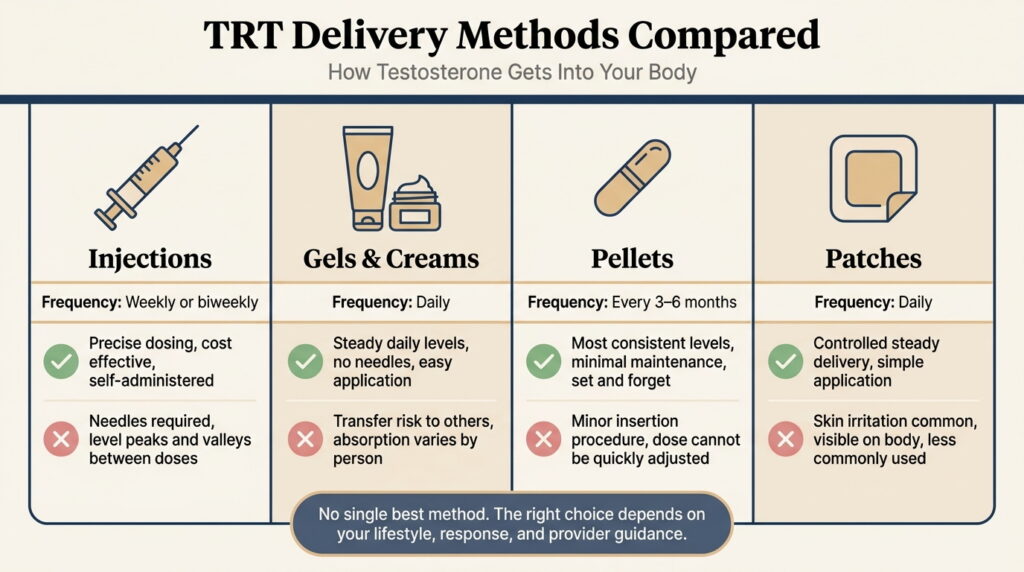
The testosterone used in TRT is bioidentical, meaning it is structurally identical to the testosterone your body produces naturally. The difference between delivery methods is not the hormone itself but how it enters your bloodstream, how consistently it maintains your levels, and how much control you have over dosing.
Intramuscular Injections
Injections are the most common form of TRT and what many clinics default to. Testosterone cypionate or testosterone enanthate is injected into a muscle, typically the gluteal muscle or the thigh. The testosterone is suspended in an oil carrier and absorbs gradually from the injection site.
Standard protocols range from once weekly to once every two weeks, though many providers now favor more frequent dosing. A weekly or even twice weekly injection schedule maintains more stable blood levels and avoids the peaks and valleys that come with less frequent injections. Those peaks and valleys are not just numbers on a lab report. Men often feel them as energy swings, mood changes, or the feeling of “wearing off” before their next injection.
Injections offer precise dosing control and are cost effective. Many men learn to self inject at home after their provider teaches proper technique. The downside is that they require needles, and levels still fluctuate between injections even on a weekly schedule.
Topical Gels and Creams
Transdermal testosterone is applied daily to the skin, usually on the shoulders, upper arms, or inner thighs. The testosterone absorbs through the skin into the bloodstream over several hours.
The advantage is steady daily dosing that avoids the sharp peaks and troughs of injections. The disadvantage is transfer risk. If someone else, especially a child or a woman, touches the application site before the gel has fully dried and absorbed, they can be exposed to testosterone. This requires consistent habits around application timing and clothing.
Absorption rates also vary between individuals. Some men absorb transdermal testosterone well and maintain good levels. Others absorb it poorly and need to switch to a different method. The only way to know is to check blood work after starting.
Subcutaneous Pellets
Pellets are small cylinders of crystallized testosterone that a provider inserts under the skin, typically in the hip or buttock area, through a minor in office procedure. The pellets dissolve slowly over three to six months, providing a sustained release of testosterone.
The appeal is convenience. Once the pellets are placed, there is nothing to remember daily or weekly. Levels tend to be remarkably stable compared to other methods. The downside is that once they are in, the dose cannot be easily adjusted. If levels come back too high or too low, you have to wait for the pellets to dissolve or have them removed, which is uncommon but possible.
Pellet therapy is what many of our patients at Lume Wellness choose because of the consistency and the fact that treatment becomes something they think about a few times per year instead of every day or every week.
Patches
Testosterone patches are applied daily, similar to gels, but with more controlled delivery. They are less commonly used now because skin irritation at the patch site is a frequent complaint, and they can be visible depending on placement.
How Long Does Testosterone Replacement Therapy Take to Work?
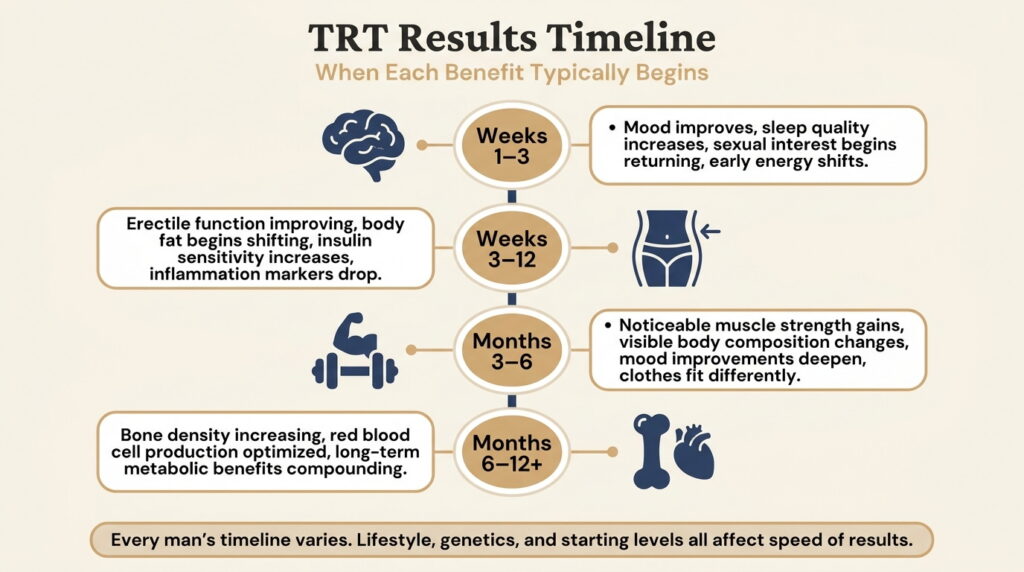
This is the question that matters most to men starting treatment, and it is the one where managing expectations makes the biggest difference.
TRT is not a switch you flip. Different systems in your body respond on different timelines because the underlying biological mechanisms are different. The most comprehensive data we have on these timelines comes from a systematic review by Saad and colleagues published in the European Journal of Endocrinology, which analyzed controlled studies spanning 35 years of research (Saad F, et al. European Journal of Endocrinology. 2011;165(5):675-685).
Here is what that research tells us about realistic timelines.
Weeks 1 Through 3: The Early Window
The first changes most men notice are not physical. They are neurological and psychological. Testosterone acts on brain receptors through non genomic pathways that operate much faster than the protein building pathways in muscle and bone.
Within the first one to three weeks, many men report improved mood stability. The general feeling of flatness or irritability that accompanies low testosterone often starts lifting. Sleep quality frequently improves, which creates a positive cascade because better sleep supports everything from energy levels to recovery to appetite regulation.
Sexual interest typically begins returning within three weeks. This is one of the most consistent early markers that treatment is working. If you are three weeks into TRT and noticing that your interest in sex is returning after months or years of decline, your treatment is on the right track even if nothing else has changed yet.
Energy levels often start improving in this window as well, though this varies more between individuals. Some men feel a noticeable shift in the first two weeks. Others take closer to six weeks. Both timelines are normal.
Weeks 3 Through 12: Building Momentum
This is where the genomic effects start becoming measurable. Your body is now actively transcribing new proteins in response to testosterone signaling, and you can start seeing and feeling the results.
Erectile function continues improving, with research showing ongoing improvement for up to six months after starting therapy. This is a gradual process, not an overnight transformation.
Body composition begins shifting in this window. The research shows changes in fat mass and lean mass starting between 12 and 16 weeks. What this looks like in real terms: your clothes may start fitting differently before the scale moves much. You might notice more definition in your shoulders or arms. Belly fat may start redistributing. These early composition changes are subtle, and men who only watch the scale often miss them.
Lipid levels begin responding around week four, with changes continuing for six to twelve months. Glycemic control and insulin sensitivity also start improving, which is particularly significant for men with metabolic syndrome or prediabetes.
Inflammatory markers begin shifting within three to twelve weeks. This matters more than most men realize because chronic inflammation is a driver of fatigue, joint pain, and cardiovascular risk.
Months 3 Through 6: Where the Real Changes Show
This is where the compounding effects become unmistakable. Muscle strength, which lags behind other markers, starts increasing noticeably between 12 and 20 weeks. Men who are combining TRT with consistent strength training see the most dramatic results in this window. The testosterone is providing the hormonal signal for muscle protein synthesis, and the training is providing the stimulus that directs where that protein goes.
Fat loss and muscle gain continue progressing. The research indicates these body composition changes continue for six to twelve months, with marginal improvements extending even further. Men who were told their “metabolism slowed down” or that they “just couldn’t build muscle anymore” often find that testosterone was the missing piece that their diet and exercise were waiting for.
Depression and mood improvements deepen. Saad’s review found that depressive mood improvements begin at three to six weeks but continue deepening for 18 to 30 weeks. This matters because many men with low testosterone are misdiagnosed with depression and prescribed antidepressants when the underlying issue was hormonal.
Months 6 Through 12 and Beyond
Bone mineral density improvements begin around the six month mark and continue for three years or more. You will not feel this happening, but it is one of the most important long term benefits of TRT, especially for men over 50 who are at increasing risk of osteoporosis.
Red blood cell production (erythropoiesis) increases over three to twelve months. This is generally beneficial, as it supports oxygen delivery to tissues and can improve exercise capacity and energy. However, it also needs monitoring because excessive red blood cell production can increase blood viscosity. This is one of the reasons regular blood work during TRT is not optional.
PSA levels and prostate volume may increase slightly over the first year, then plateau. Current evidence, including the TRAVERSE trial discussed below, does not support the old concern that TRT causes prostate cancer. But monitoring PSA is still standard practice to track prostate health.
Why Results Vary Between Men
Two men can start the same TRT protocol on the same day and have noticeably different experiences. This is not because the treatment works for some and not others. It is because of individual variation in several factors.
Androgen receptor density and sensitivity vary genetically. A man with more androgen receptors or more sensitive receptors will respond more robustly to the same testosterone level. SHBG levels affect how much testosterone remains free and active. Men with high SHBG may have good total testosterone numbers but low free testosterone, which is the fraction that actually works.
Starting point matters enormously. A man whose testosterone was severely deficient (under 200 ng/dL) will typically notice more dramatic improvements than a man who was borderline low (around 280 to 300 ng/dL). The depth of the deficit affects the magnitude of the recovery.
Lifestyle factors amplify or blunt the effects of TRT. A man who starts treatment, improves his sleep, manages his stress, eats adequate protein, and trains consistently will see far better results than a man who starts treatment and changes nothing else. TRT restores the hormonal foundation. What you build on that foundation is still up to you.
Other hormonal issues also play a role. Thyroid dysfunction, elevated cortisol, insulin resistance, and even estrogen imbalances in men can all interfere with how well TRT works. This is why a functional medicine approach that evaluates the entire hormonal picture, rather than just prescribing testosterone in isolation, produces better outcomes.
Safety: What the Largest Clinical Trial Tells Us
For years, the biggest concern about TRT was cardiovascular risk. A handful of smaller studies and observational data suggested testosterone therapy might increase the risk of heart attack and stroke. This concern shaped prescribing patterns and made many men and their doctors hesitant about treatment.
The TRAVERSE trial put this question to rest. Published in the New England Journal of Medicine in 2023, TRAVERSE was the largest randomized, double blind, placebo controlled trial of testosterone therapy ever conducted (Nissen SE, et al. New England Journal of Medicine. 2023. doi:10.1056/NEJMoa2215025).
The study enrolled 5,204 men between ages 45 and 80 who had documented hypogonadism (testosterone below 300 ng/dL) and either preexisting cardiovascular disease or high cardiovascular risk factors. These were not young, healthy men. They were the exact population you would be most worried about if testosterone were truly dangerous for the heart.
After a mean follow up of 33 months, the primary composite endpoint of cardiovascular death, nonfatal heart attack, or nonfatal stroke occurred in 7.0% of the testosterone group versus 7.3% of the placebo group. The hazard ratio was 0.96, meaning testosterone therapy was statistically noninferior to placebo for cardiovascular events. In plain language: TRT did not increase cardiovascular risk even in men who already had heart disease or were at high risk for it.
The study did identify three adverse events that were slightly more common with testosterone: atrial fibrillation (3.5% vs 2.4%), acute kidney injury (2.3% vs 1.5%), and pulmonary embolism (0.9% vs 0.5%). These are not reasons to avoid TRT, but they are reasons why proper monitoring and provider oversight are essential.
Other Safety Considerations
Beyond cardiovascular concerns, TRT has a well established safety profile when monitored appropriately. The most common side effect is polycythemia, an increase in red blood cell count that can thicken the blood. Regular complete blood count (CBC) monitoring catches this, and the solution is usually a dose adjustment or therapeutic blood donation.
Acne and oily skin can occur, particularly in the early months, as your body adjusts to higher androgen levels. This typically resolves or becomes manageable.
Testicular atrophy and reduced sperm production are expected consequences of HPG axis suppression, as discussed earlier. For men who want to maintain fertility, strategies like adding human chorionic gonadotropin (hCG) to the protocol can help maintain testicular function and sperm production while on TRT.
Mood changes, specifically increased irritability, are sometimes reported but are more commonly associated with supraphysiological doses (levels pushed above the normal range) or with the peak and valley pattern of infrequent injection schedules. Proper dosing and consistent delivery largely prevent this.
Monitoring: What Your Provider Should Be Tracking
TRT is not a “set it and forget it” treatment. It requires ongoing lab work and clinical evaluation, especially in the first year. Here is what responsible monitoring looks like.
Before starting treatment: A comprehensive lab panel should include total testosterone (drawn in the morning when levels peak), free testosterone, SHBG, estradiol (estrogen), complete blood count, comprehensive metabolic panel, lipid panel, PSA, LH, FSH, thyroid function, and fasting insulin or glucose. Two separate morning testosterone readings below 300 ng/dL are the standard threshold for diagnosis, though some men are clearly symptomatic at levels that technically fall within the “normal” range.
At 6 to 12 weeks after starting: Repeat testosterone levels to confirm the chosen dose is achieving target levels. Check estradiol, CBC, and metabolic markers. This is where dose adjustments happen. Starting doses are educated estimates. Blood work tells you whether the estimate was right.
Every 6 to 12 months ongoing: Regular monitoring of all the above, plus PSA for prostate health and a clinical evaluation of symptoms. The goal is not just to get testosterone numbers into a target range. The goal is to optimize how you feel and function while keeping all safety markers in check.
This is where many men run into problems with TRT clinics that focus solely on testosterone levels. A number on a lab report does not tell the whole story. Your provider should be asking about your sleep, your energy, your mood, your exercise capacity, and your overall quality of life at every follow up.
The Functional Medicine Approach to TRT
Standard TRT clinics tend to follow a straightforward model: measure testosterone, prescribe testosterone, recheck testosterone. There is nothing wrong with this as far as it goes. The hormone is effective and the approach works for many men.
But testosterone does not exist in a vacuum. It is one node in a complex web of hormonal, metabolic, and neurological systems that all influence each other. This is where a functional medicine approach adds value that a testosterone only protocol cannot.
At Lume Wellness, we look at the complete picture. If a man comes in with low testosterone, we want to know why. Is it purely age related decline? Is chronic stress suppressing his HPG axis through elevated cortisol? Is he insulin resistant, which disrupts hormonal signaling across the board? Is his thyroid function suboptimal, which affects energy, metabolism, and the way his body uses testosterone? Is he converting too much testosterone to estrogen through aromatase activity driven by excess body fat?
These questions change the treatment plan. A man with low testosterone and significant insulin resistance benefits from addressing both issues simultaneously. Optimizing testosterone alone without addressing insulin resistance leaves a major metabolic driver untouched, and his results will be slower and less complete than they could be.
Similarly, a man with low testosterone and poor sleep quality needs both hormone optimization and a sleep strategy. The testosterone will improve his sleep to some degree, but if underlying sleep apnea, circadian disruption, or chronic stress are driving the problem, those need direct attention.
This layered approach is what separates functional medicine TRT from the assembly line model. It takes longer to set up, requires more comprehensive testing, and demands a provider who understands the interplay between systems. But the outcomes are measurably better because you are not just replacing a hormone. You are restoring the conditions that allow that hormone to work at its full potential.
When TRT Might Not Be the Right Answer
TRT is powerful, but it is not appropriate for everyone. There are situations where other approaches should come first, or where TRT carries risks that outweigh its benefits.
Men with active prostate cancer or breast cancer should not use TRT, as testosterone can fuel hormone sensitive cancers. Men with untreated severe sleep apnea need to address the sleep apnea first, as TRT can worsen it. Men with very high red blood cell counts (hematocrit above 54%) are at increased risk for blood clots and need to resolve that issue before starting testosterone.
For younger men, particularly those under 35 with borderline testosterone levels and no structural or genetic cause for hypogonadism, the better starting point is usually lifestyle optimization. Sleep, stress management, body composition improvement, and nutritional changes can raise testosterone levels meaningfully in men whose production capacity is intact but suppressed by modifiable factors. If those interventions do not produce adequate results after a reasonable period, then TRT becomes a conversation worth having.
Fertility is another critical factor. As discussed, TRT suppresses sperm production. Men who are actively trying to conceive, or who want to preserve the option in the near future, need to have a frank discussion about this before starting treatment. There are alternatives and adjunct therapies that can maintain fertility, but they need to be part of the plan from day one, not an afterthought.
Frequently Asked Questions
Does TRT cause weight loss?
TRT is not a weight loss drug. What it does is restore the hormonal conditions that make fat loss possible. Testosterone increases lean muscle mass, which raises your resting metabolic rate. It improves insulin sensitivity, which helps your body process glucose more efficiently rather than storing it as fat. And it enhances energy and motivation, which makes consistent exercise feel achievable rather than impossible. Men who combine optimized testosterone with proper nutrition and training typically see meaningful body composition changes over three to six months.
Is TRT the same as steroids?
TRT uses the same molecule that your body produces naturally. The difference between TRT and anabolic steroid abuse is intent, dosing, and medical supervision. TRT aims to restore testosterone to normal physiological levels, typically 500 to 900 ng/dL. Steroid abuse pushes levels far above the natural range, often to 2,000 ng/dL or higher, which is where serious health risks emerge. Comparing medically supervised TRT to steroid abuse is like comparing a prescribed dose of ibuprofen to swallowing the entire bottle.
Will TRT make me aggressive?
This is one of the most persistent myths about testosterone therapy, and the research does not support it. Studies consistently show that men on TRT within physiological ranges experience improved mood stability, reduced irritability, and better emotional regulation. The “roid rage” association comes from supraphysiological doses used in steroid abuse, not from medically supervised replacement therapy.
Can I stop TRT once I start?
Yes, you can stop TRT at any time. However, if you stop, your testosterone levels will return to wherever they were before you started, because TRT does not fix the underlying production issue. It manages it. Some men experience a temporary period of feeling worse than baseline after stopping because their natural production, which was suppressed during treatment, takes time to restart. This recovery period varies but typically resolves within several weeks to a few months.
Does TRT affect fertility?
TRT suppresses the HPG axis, which reduces LH and FSH production, which in turn reduces sperm production. For some men, sperm counts drop to zero during treatment. This is typically reversible after stopping TRT, but recovery can take months. Men who want to preserve fertility while on TRT can discuss adding hCG (human chorionic gonadotropin) to their protocol, which mimics LH and maintains testicular function. This should be addressed before starting treatment, not after.
How do I know if I need TRT?
The diagnosis requires both symptoms and confirmed low testosterone on blood work. Symptoms of low testosterone include persistent fatigue that sleep does not resolve, decreased sex drive, erectile difficulties, loss of muscle mass despite training, increased body fat especially around the midsection, brain fog, mood changes including irritability or depression, and decreased motivation. If you have several of these symptoms, a comprehensive hormone panel is the logical next step. Two morning blood draws showing total testosterone below 300 ng/dL, combined with symptoms, is the standard diagnostic threshold.
What is the best delivery method for TRT?
There is no single best method. The right choice depends on your lifestyle, your response to treatment, your provider’s recommendation, and your personal preferences. Injections offer precise dosing and cost effectiveness but require needles and produce level fluctuations. Gels provide daily steady dosing but carry transfer risks. Pellets offer months of consistent levels with minimal maintenance but do not allow quick dose adjustments. Many men try one method and switch to another based on how they respond. Your provider should be open to finding what works best for you specifically.
Are there natural ways to boost testosterone before trying TRT?
Yes, and this is often the right starting point, especially for younger men or those with borderline levels. Sleep optimization has a significant impact because testosterone production occurs primarily during deep sleep. Resistance training, particularly compound lifts, stimulates testosterone production acutely and supports it long term through improved body composition. Maintaining a healthy body weight matters because adipose tissue converts testosterone to estrogen through aromatase activity. Stress management lowers cortisol, which directly suppresses the HPG axis. Adequate zinc, vitamin D, and magnesium intake support testosterone synthesis. These interventions are not guaranteed to resolve clinically low testosterone, but they can make a measurable difference and should be part of your treatment plan regardless of whether you start TRT.