
If you’ve been dragging through your days with zero energy, losing interest in sex, or noticing a gut that won’t go away no matter what you do — your testosterone levels might be the problem.
Low testosterone (clinically called male hypogonadism) affects roughly 40% of men over 45 and an increasing number of younger men too. But here’s the frustrating part: most guys don’t realize they have it. The symptoms creep in slowly, and it’s easy to blame stress, aging, or just “getting older.”
You don’t have to guess. This guide breaks down every sign of low testosterone — sexual, physical, and mental — so you can figure out if what you’re experiencing is normal aging or something that actually needs attention.
Quick Answer: Low testosterone means your levels have dropped below 300 ng/dL (the clinical threshold set by the American Urological Association). Common signs include low sex drive, erectile dysfunction, fatigue that doesn’t improve with rest, muscle loss, increased belly fat, depression, brain fog, and irritability. Around 40% of men over 45 are affected, and research shows testosterone levels in young men have dropped roughly 25% since 1999 — meaning this isn’t just an older man’s issue anymore.
What Does Low Testosterone Actually Mean?
Testosterone is the primary male sex hormone, produced mainly in your testicles with small amounts from your adrenal glands. It does a lot more than drive your sex life — it regulates muscle mass, bone density, red blood cell production, fat distribution, mood, and cognitive function.
Your brain controls the whole process through something called the HPG axis. Your hypothalamus sends a signal (GnRH) to your pituitary gland, which releases LH and FSH, which then tell your testes to produce testosterone. When levels get high enough, your brain dials back the signal. It’s a feedback loop, and when any part of it breaks down, your testosterone drops.
The American Urological Association defines low testosterone as a total testosterone level below 300 ng/dL, confirmed by at least two morning blood tests. But that number alone doesn’t tell the whole story.
Total Testosterone vs. Free Testosterone
Here’s something most articles won’t tell you: only about 2-5% of your testosterone is actually “free” — meaning it’s biologically active and doing work in your body. The rest is bound to proteins (mainly SHBG and albumin) and can’t enter your cells.
That matters because you can have a total testosterone reading of 350 ng/dL — technically “normal” — and still feel terrible if your SHBG is high and your free testosterone is in the basement. This is especially common in men who are overweight, over 50, or taking certain medications.
If you’re getting tested and your total T comes back borderline (anywhere from 250-400 ng/dL) but you’ve got symptoms, ask your provider to check free testosterone and SHBG too. It could change the picture completely.
What’s “Normal” at Your Age?
Testosterone doesn’t stay the same your whole life. It peaks in your late teens to early 20s, then gradually declines about 1-2% per year after age 30. Here’s what the research shows for average ranges by decade:
| Age Group | Average Range (ng/dL) |
|---|---|
| 20-24 | 409-558 |
| 25-29 | 413-575 |
| 30-34 | 359-498 |
| 35-39 | 352-478 |
| 40-44 | 350-473 |
| 50s | 215-878 |
| 60s | 196-859 |
| 70+ | 156-819 |
Source: 2022 age-stratified testosterone study; ranges represent approximately the 25th-75th percentiles
Notice how wide those ranges get as men age. A 55-year-old with a level of 280 ng/dL is below the diagnostic cutoff, while his neighbor at 650 ng/dL is perfectly healthy. That’s why symptoms matter just as much as the number.
Who’s at Risk? It’s Not Just Older Men Anymore
The Generational Decline Nobody’s Talking About
This data point should concern every man under 40: testosterone levels in young American men dropped 25.5% between 1999 and 2016.
NHANES data (the largest ongoing health survey in the U.S.) showed that the average testosterone level in men ages 15-39 fell from 605 ng/dL to 451 ng/dL in just 17 years. That’s not an aging issue — these are young men being compared to young men a generation earlier.
Researchers point to several factors driving this decline:
- Rising obesity rates (fat tissue contains aromatase, an enzyme that converts testosterone into estrogen)
- Endocrine disruptors in everyday products — BPA in food packaging, phthalates in personal care products, PFAS in nonstick cookware and water supplies
- Sedentary lifestyles and screen-heavy routines
- Chronic stress from work culture and financial pressure
- Ultra-processed diets replacing whole foods
- Poor sleep patterns driven by screen time and shift work
The Obesity-Testosterone Cycle
This is one of the most important connections most men don’t understand, and it creates a vicious cycle:
Excess body fat (especially visceral belly fat) contains the aromatase enzyme, which actively converts your testosterone into estrogen. Lower testosterone then makes it harder to build muscle and easier to store fat — which produces even more aromatase — which converts even more testosterone. Around and around it goes.
The numbers back this up. According to the Urology Care Foundation, 30% of overweight men have low testosterone compared to just 6.4% of men at a healthy weight. Among obese men, 52.4% had levels below 300 ng/dL.
That’s not a small difference. It’s nearly a 5x higher risk.
Medications That Can Tank Your Testosterone
Several common prescriptions can lower testosterone, and your doctor may not mention it:
| Medication Type | Examples | How It Affects T |
|---|---|---|
| Opioid pain medications | Oxycodone, hydrocodone, morphine | Suppresses GnRH signal from brain |
| Corticosteroids | Prednisone, dexamethasone | Directly suppresses HPG axis |
| Some antidepressants | SSRIs (sertraline, fluoxetine) | May lower T through serotonin pathways |
| Hair loss drugs | Finasteride (Propecia) | Blocks DHT conversion; can lower free T |
| Anabolic steroids | Past or current use | Shuts down natural production (most common cause in young men) |
| Statins | Atorvastatin, rosuvastatin | Some evidence of modest T reduction |
If you’re on any of these and experiencing symptoms, it’s worth a conversation with your provider — not to stop the medication, but to check your levels and explore options.
Sexual Signs of Low Testosterone
Sexual symptoms are usually the ones that get men’s attention first, and for good reason — they’re hard to ignore.
Low Sex Drive (Decreased Libido)
This is the most commonly reported symptom, showing up in virtually every clinical study on hypogonadism. We’re not talking about a gradual, mild shift in interest — though that happens with age. Low-T libido loss feels more like a switch got flipped. The desire you used to feel just… isn’t there.
Some men describe it as going from thinking about sex multiple times a day to barely thinking about it once a week. If your partner is noticing before you are, that’s a sign worth paying attention to.
Erectile Dysfunction
Testosterone doesn’t directly cause erections — that’s mostly a nitric oxide and blood flow process. But testosterone signals your brain to trigger nitric oxide production, so when T drops, the whole cascade slows down.
Low-T-related ED typically shows up as erections that aren’t as firm, don’t last as long, or require more stimulation to achieve. ED has many causes (cardiovascular issues, diabetes, medications, anxiety), so it’s not automatically a testosterone problem. But if ED shows up alongside other symptoms on this list, low T should be on the table.
Fewer Morning Erections
This is one of the earliest and most reliable signs, and it’s often overlooked. Healthy men typically experience 3-5 erections during sleep (nocturnal penile tumescence), with one usually present upon waking. These are largely testosterone-driven.
If you used to wake up with morning erections regularly and now rarely do, that’s your body giving you a pretty direct signal that testosterone may be dropping. It’s one of the first symptoms clinicians ask about during evaluation.
Reduced Semen Volume and Fertility Issues
Testosterone plays a direct role in sperm production. Low levels can reduce both sperm count and semen volume — the amount of fluid produced during ejaculation may noticeably decrease.
For men trying to conceive, this connection matters. And it’s worth knowing that standard testosterone replacement therapy can actually suppress sperm production further, which is why fertility-preserving alternatives like clomiphene citrate or hCG exist for men who want to treat low T without compromising their ability to have children.
Genital Numbness or Reduced Sensitivity
This one rarely makes the lists, but men with low testosterone sometimes report decreased sensation in the genital area. Things just don’t feel as intense as they used to — during sex or otherwise. It’s related to testosterone’s role in maintaining nerve sensitivity and blood flow to the tissues.
Physical Signs of Low Testosterone
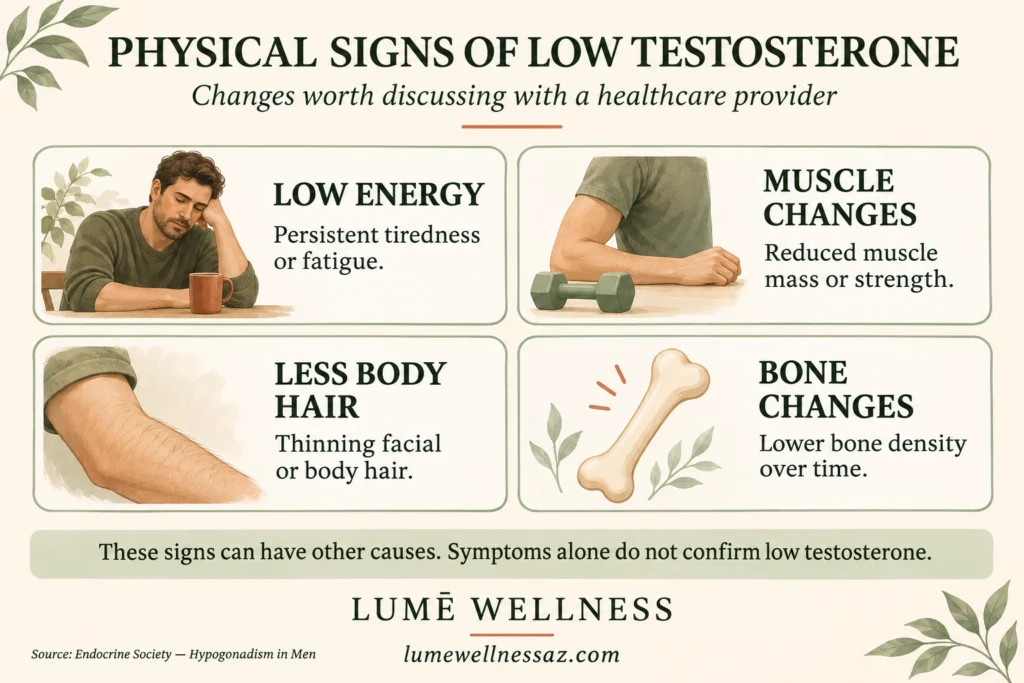
These are the symptoms that affect your daily life, your energy, and what you see in the mirror.
Constant Fatigue That Sleep Doesn’t Fix
Not regular tiredness. The kind of fatigue where you sleep 8 hours and wake up feeling like you got 4. Where you need a nap by 2 PM regardless of what you ate for lunch. Where the couch is more appealing than anything else on your calendar.
This is one of the most reported symptoms, and it’s also one of the trickiest because fatigue has a hundred possible causes. But low-T fatigue has a specific quality to it — it’s persistent, it doesn’t respond to rest, and it usually comes with other symptoms from this list.
A telling detail: the Sleep Foundation and a University of Chicago study found that men who slept only 5 hours per night saw their testosterone drop by 10-15%. So poor sleep tanks your T, and low T disrupts your sleep — another vicious cycle.
Losing Muscle Mass and Strength
Testosterone is one of the most powerful anabolic hormones in your body. It directly stimulates muscle protein synthesis. When levels drop, you lose lean muscle mass even if your workout routine hasn’t changed.
Men often notice it first as decreased strength — weights that used to feel manageable now feel heavier, or muscles look softer and less defined despite consistent training. Some men also report decreased exercise tolerance, where workouts that used to feel routine now leave them unusually wiped out.
Gaining Body Fat (Especially Around the Midsection)
Low testosterone shifts your body composition toward fat storage, particularly in the abdominal area. Some men develop visceral fat (the deep belly fat that wraps around organs) that seems resistant to diet and exercise.
This isn’t just cosmetic. Visceral fat is metabolically active and directly contributes to the aromatase-driven testosterone-to-estrogen conversion cycle discussed earlier. It also raises your risk for cardiovascular disease, type 2 diabetes, and metabolic syndrome.
Gynecomastia (Male Breast Tissue Growth)
When testosterone drops and estrogen relatively increases (either through the aromatase conversion or from an actual hormone imbalance), some men develop enlarged breast tissue. This isn’t just chest fat — gynecomastia involves actual glandular tissue growth behind the nipple area.
It can be one-sided or both sides, tender or painless. It affects roughly 30-40% of men with significant testosterone deficiency and is one of the symptoms men find most distressing.
Thinning Body and Facial Hair
Testosterone and its derivative DHT drive body and facial hair growth. When levels drop, some men notice their beard grows slower, body hair thins, or hair on their legs and arms becomes sparser.
This is different from male pattern baldness on your head (which is actually driven by DHT sensitivity, not low testosterone). We’re talking about reduced growth everywhere else.
Decreased Bone Density
Testosterone helps maintain bone mineral density throughout your life. Chronically low levels can lead to osteopenia (mildly reduced bone density) or osteoporosis (significantly reduced), increasing your fracture risk — especially in the hips, spine, and wrists.
This is a symptom most men never think about because it’s invisible until a fracture happens. Men with long-term untreated low testosterone have measurably higher rates of osteoporotic fractures, and it’s one of the strongest arguments for not ignoring persistent low T.
Hot Flashes and Night Sweats
Yes, men get hot flashes. It surprises most guys to learn this, but sudden waves of heat, flushing, and sweating — especially at night — are well-documented symptoms of testosterone deficiency. The mechanism is similar to what women experience during menopause: the hypothalamus (your body’s thermostat) becomes more sensitive when sex hormones drop.
If you’re soaking through sheets at night and can’t explain it, low testosterone belongs on the list of possibilities.
Smaller Testicles
The testes both produce and respond to testosterone. When levels are chronically low — particularly in secondary hypogonadism where the brain’s signal to the testes has decreased — the testicles can physically shrink (testicular atrophy). This is also very common in men who have used anabolic steroids, as external testosterone shuts down the brain’s signal entirely.
Anemia (Low Red Blood Cell Count)
Testosterone stimulates erythropoiesis — the production of red blood cells in your bone marrow. Men with low T sometimes develop mild anemia, which shows up as additional fatigue, shortness of breath with mild exertion, pale skin, or feeling lightheaded when standing.
A complete blood count (CBC) is part of standard low-T workup for exactly this reason. It’s also why hematocrit levels need monitoring during TRT — treatment can sometimes push red blood cell production too high.
Mental and Emotional Signs of Low Testosterone
These symptoms are often the most life-disrupting and the ones most likely to be misdiagnosed as something else entirely.
Depression and Low Mood
The connection between low testosterone and depression is one of the strongest in the research. A study in the Journal of Sexual Medicine found that 56% of men with borderline low testosterone had clinically significant depression.
A massive UK Biobank study tracking 133,733 men found that low free testosterone was associated with roughly double the risk of depression. Among men ages 50-54, low free T was linked to 5 times the risk of anxiety.
Here’s the tricky part: depression itself can lower testosterone (the stress-cortisol connection), so it becomes a chicken-or-egg problem. That’s why full hormone testing matters — if your depression started around the same time as fatigue, low libido, and body changes, hormone levels deserve a look.
Irritability and Mood Swings
Unexplained anger, a shorter fuse than usual, or emotional reactions that seem disproportionate — these are common with low T and often the first thing partners notice. Some men describe it as feeling “on edge” constantly, or getting angry about things that wouldn’t have bothered them before.
This isn’t about having a bad day. It’s a pattern — weeks or months of emotional volatility that doesn’t match your circumstances.
Anxiety
While depression gets more attention, anxiety is an underrecognized symptom of low testosterone. That UK Biobank data showing a 5x anxiety risk in men 50-54 with low free T is striking. Generalized worry, nervousness in situations that never bothered you before, or a persistent feeling that something is wrong — all of these can have a hormonal component.
Brain Fog and Memory Problems
Difficulty concentrating, struggling to find words, walking into a room and forgetting why you’re there, feeling like your mental sharpness has dulled — this constellation of symptoms is what patients typically call “brain fog.”
Testosterone receptors exist throughout the brain, including areas responsible for memory and executive function. When levels drop, cognitive processing can measurably slow down. Men frequently describe it as feeling like they’re “thinking through mud.”
Low Motivation and Confidence
The drive to pursue goals, take on challenges, or even just engage with your daily life — testosterone influences all of it. Men with low T often describe a pervasive sense of apathy. Projects they used to be excited about feel meaningless. Ambitions they used to have feel distant.
This is different from laziness. It’s a neurochemical shift that makes everything feel harder and less rewarding.
Sleep Problems
Low testosterone disrupts sleep architecture, and poor sleep further lowers testosterone — yet another bidirectional cycle. Men with low T often report difficulty falling asleep, restless nights, frequent waking, or sleeping long hours without feeling restored.
Untreated sleep apnea is both a cause and consequence of low testosterone, which is why a sleep evaluation is often part of a thorough hormone workup.
Signs of Low Testosterone by Age
Symptoms don’t show up the same way at every age. Here’s what tends to appear by decade:
| Age Group | Most Common Symptoms | What’s Often Missed |
|---|---|---|
| 20s-30s | Low libido, fatigue, difficulty building muscle, brain fog, mood changes | Often dismissed as stress or lifestyle; generational decline means more young men are affected than ever |
| 40s | ED, weight gain (especially belly), declining energy, irritability, reduced morning erections | Symptoms blamed on “just getting older”; borderline T levels often not investigated |
| 50s-60s | Bone density loss, muscle wasting, depression, hot flashes, sleep disruption, anemia | Overlap with other age-related conditions masks the hormonal component |
| 70+ | Severe fatigue, cognitive decline, osteoporosis, frailty, loss of independence | Treatment decisions weigh more carefully against individual health status |
The key takeaway: if you’re in your 20s or 30s experiencing these symptoms, don’t let anyone tell you you’re too young. The data says otherwise.
How Low Testosterone Is Diagnosed
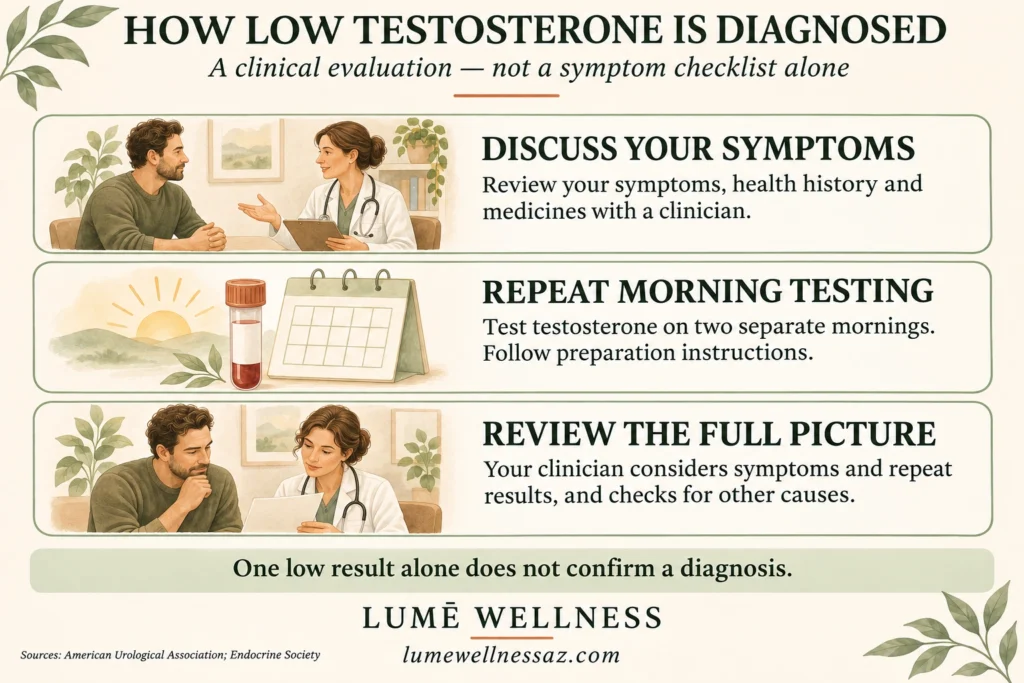
The Two-Test Morning Protocol
Diagnosing low T isn’t a single blood draw. The American Urological Association requires:
- First blood test — Total testosterone, drawn between 7-10 AM when levels naturally peak (fasting is preferred)
- Confirmatory second test — On a different day, also in the morning
Both results need to come back below 300 ng/dL, combined with symptoms, for a clinical diagnosis. Morning timing matters because testosterone can drop 20-25% by afternoon, which could make a normal reading look low or a low reading look borderline.
What Else Gets Checked
A thorough workup goes well beyond testosterone. Your provider should also look at:
| Test | Why It Matters |
|---|---|
| Free testosterone | Shows bioavailable T; important if total T is borderline |
| LH and FSH | Determines if the problem is in the testes (primary) or brain signaling (secondary) |
| SHBG | High SHBG binds more T, reducing the active fraction |
| Prolactin | Elevated levels can indicate pituitary issues |
| Estradiol | Checks for excess estrogen conversion |
| CBC (Complete Blood Count) | Screens for anemia and establishes baseline hematocrit |
| Comprehensive Metabolic Panel | Kidney and liver function, blood sugar |
| Thyroid panel | Thyroid dysfunction mimics many low-T symptoms |
| PSA | Baseline prostate screening before any TRT consideration |
| Lipid panel | Cardiovascular risk baseline |
The Borderline Zone: 250-400 ng/dL
Plenty of men fall into this gray area — technically “in range” at some labs, below the cutoff at others, and symptomatic regardless. This is where free testosterone testing becomes especially important and where clinical judgment matters.
If your total T is 320 ng/dL but your free T is low, your SHBG is high, and you’ve got five symptoms from this list — that’s a different clinical picture than a 320 reading with no symptoms and normal free T.
Self-Assessment: The ADAM Questionnaire
Before (or alongside) blood work, the Androgen Deficiency in Aging Males (ADAM) questionnaire gives you a quick self-check. If you answer “yes” to question 1 or 7, or “yes” to any 3 other questions, clinical evaluation is recommended:
- Do you have a decrease in libido (sex drive)?
- Do you have a lack of energy?
- Do you have a decrease in strength and/or endurance?
- Have you lost height?
- Have you noticed a decreased enjoyment of life?
- Are you sad and/or grumpy?
- Are your erections less strong?
- Have you noticed a recent deterioration in your ability to play sports?
- Are you falling asleep after dinner?
- Has there been a recent deterioration in your work performance?
This isn’t a diagnosis — it’s a screening tool. But if you’re hitting multiple “yes” answers, it’s worth getting blood work done.
What Happens If You Ignore Low Testosterone
Untreated low testosterone isn’t just about feeling lousy today. Over months and years, it can lead to:
- Osteoporosis and fractures — Chronically low T weakens bones progressively. Hip fractures in men carry a higher mortality rate than in women.
- Cardiovascular and metabolic risks — Low T is associated with metabolic syndrome, insulin resistance, and unfavorable lipid profiles.
- Worsening depression — The bidirectional relationship means untreated low T and untreated depression can feed each other indefinitely.
- Muscle wasting and frailty — Progressive loss of lean mass increases fall risk and reduces independence, especially in older men.
- Relationship strain — Low libido, irritability, fatigue, and emotional withdrawal don’t just affect you. Partners often bear the weight of symptoms they don’t understand, and many couples struggle for years before the hormonal cause is identified.
- Reduced quality of life — This is the bottom line. Men with untreated hypogonadism consistently report lower quality of life scores across every measured domain — physical, sexual, emotional, and social.
The good news: most of these consequences are reversible or improvable with appropriate treatment.
Treatment Options: From Lifestyle Changes to TRT
Evidence-Based Natural Ways to Support Testosterone
Before jumping to medication, lifestyle interventions can make a real difference — especially for men whose levels are borderline or whose decline is lifestyle-driven:
Strongest evidence:
- Resistance training — Compound lifts (squats, deadlifts, bench press, rows) trigger the largest acute testosterone responses. Consistency matters more than intensity.
- Sleep optimization — Target 7-9 hours. The University of Chicago study showing a 10-15% T drop from just one week of 5-hour nights should be enough motivation.
- Weight loss — Dropping visceral belly fat directly reduces aromatase activity and breaks the obesity-low T cycle. Even a 10% reduction in body weight can noticeably improve testosterone levels.
- Stress management — Cortisol and testosterone operate on a seesaw. When cortisol stays chronically elevated, your HPG axis gets suppressed. Whatever works for you — exercise, mindfulness, boundaries, therapy — the testosterone benefit is real.
Moderate evidence:
- Vitamin D supplementation — One study showed 3,332 IU daily for one year increased T by roughly 25% in men who were deficient. Given that vitamin D deficiency is extremely common, it’s low-hanging fruit.
- Zinc — Your body needs zinc to produce testosterone. If you’re deficient (common in men who don’t eat much red meat or shellfish), supplementation can help. Oysters, pumpkin seeds, and beef are top food sources.
- Reducing alcohol — Testosterone drops within 30 minutes of alcohol consumption, and heavy drinking damages the Leydig cells in your testes that produce T.
- Minimizing endocrine disruptors — Switching from plastic food containers to glass, choosing personal care products without phthalates, filtering drinking water — these won’t dramatically change your levels overnight, but reducing chronic exposure matters for long-term hormonal health.
When TRT Makes Sense
Testosterone replacement therapy becomes the conversation when:
- Levels are confirmed below 300 ng/dL on two morning tests
- Symptoms are affecting your quality of life
- Lifestyle interventions alone haven’t moved the needle
- There are no contraindications (active prostate or breast cancer, uncontrolled heart failure, plans to conceive without fertility-preserving protocol, untreated sleep apnea)
TRT Delivery Methods
| Method | How It Works | Frequency | Key Consideration |
|---|---|---|---|
| Topical gel | Applied to shoulders/upper arms | Daily | Transfer risk to partners and children through skin contact |
| Intramuscular injection | Injected into muscle (cypionate or enanthate) | Every 1-2 weeks | Most cost-effective; some men experience peaks and valleys |
| Subcutaneous pellets | Implanted under skin in a brief office visit | Every 3-6 months | Consistent levels with minimal maintenance; can’t easily adjust dose |
| Transdermal patch | Applied to skin nightly | Daily | Steady absorption; skin reactions are common |
| Nasal gel | Applied inside nostrils | 2-3x daily | No transfer risk; requires frequent dosing |
| Oral capsule | Taken with food | 2x daily | Convenient; must be taken with fat-containing meal |
Your provider will help determine which delivery method fits your life, your preferences, and your clinical picture. There’s no single “best” method — it depends on you.
The 2025 FDA Safety Update
For years, one of the biggest barriers to TRT was fear of cardiovascular risk. In 2015, the FDA placed a black box warning on testosterone products suggesting increased heart attack and stroke risk.
That changed in February 2025. Based on the TRAVERSE trial — a landmark randomized controlled study of 5,246 men published in the New England Journal of Medicine in 2023 — the FDA removed the cardiovascular black box warning from testosterone products. The trial showed that TRT did not increase the rate of major adverse cardiovascular events compared to placebo.
This doesn’t mean TRT is risk-free. Monitoring hematocrit, PSA, and cardiovascular markers remains part of responsible hormone management. But the cloud of cardiac fear that hung over testosterone therapy for nearly a decade has been substantially lifted by high-quality evidence.
Fertility Considerations
Standard TRT suppresses your natural testosterone production, which means it also suppresses sperm production. For men who want to preserve fertility, alternatives include:
- Clomiphene citrate — Stimulates your pituitary to produce more LH and FSH, which boosts your own testosterone production while maintaining sperm output
- hCG (human chorionic gonadotropin) — Mimics LH directly, keeping the testes active. Can be used alone or alongside TRT
- Enclomiphene — A newer, more targeted version of clomiphene with fewer side effects (currently under study)
If starting a family is in your plans, make sure your provider knows before beginning any testosterone treatment.
Frequently Asked Questions
What’s the number-one cause of low testosterone?
Aging is the most common factor — testosterone naturally declines about 1-2% per year after 30. But obesity is probably the most correctable cause. With 30% of overweight men and over 52% of obese men testing below 300 ng/dL, body composition plays a massive role. Other common causes include chronic stress, sleep deprivation, opioid medications, and type 2 diabetes.
At what age does testosterone start declining?
Most men begin a gradual decline around age 30, though you won’t typically notice symptoms for another decade or two. The decline isn’t uniform — some men maintain healthy levels well into their 70s, while others drop below the threshold in their 40s. Genetics, body composition, lifestyle, and overall health all influence your personal trajectory.
Can you reverse low testosterone without medication?
In many cases, yes — especially if the cause is lifestyle-related. Men with obesity-driven low T who lose significant weight often see their levels rebound. Improving sleep from 5-6 hours to 7-9 hours alone can boost T by 10-15%. Resistance training, stress reduction, and stopping medications that suppress testosterone (under medical guidance) can also help. That said, if your levels are well below 300 ng/dL or you have primary hypogonadism, lifestyle changes alone may not be enough.
What testosterone level is dangerously low?
There’s no universally agreed “dangerous” number, but levels below 200 ng/dL are considered severe hypogonadism and typically cause significant symptoms. Below 150 ng/dL, risks like osteoporosis, severe depression, anemia, and metabolic syndrome increase substantially. The clinical cutoff for diagnosis is 300 ng/dL, but symptoms can start appearing well above that — especially if free testosterone is low.
Does low testosterone cause weight gain?
It contributes to it, yes. Low T shifts body composition toward fat storage (particularly visceral belly fat) and away from lean muscle mass. And because fat tissue actively converts testosterone to estrogen via aromatase, weight gain lowers T further. Breaking this cycle often requires addressing both the hormonal and metabolic sides simultaneously.
Can stress really lower testosterone?
Absolutely. Chronic stress elevates cortisol, which directly suppresses the hypothalamic-pituitary-gonadal axis — the brain-to-testes signaling system. It’s not about one stressful week tanking your levels. It’s months or years of sustained high cortisol that gradually erodes your testosterone production. This is one reason men in high-stress professions, financial difficulty, or caregiver roles are disproportionately affected.
What does low testosterone actually feel like day-to-day?
Men typically describe it as a general “flatness.” You’re tired but can’t sleep well. You’re not interested in things you used to enjoy. Your body feels heavier and less responsive. Sex sounds like more effort than reward. Concentration takes real effort. You’re irritable for no clear reason. It’s not dramatic — it’s more like someone slowly turned down the volume on everything in your life over six months without you noticing.
How quickly does TRT start working?
It depends on the symptom. Libido improvements often show up within 3-6 weeks. Energy and mood typically improve within 4-8 weeks. Body composition changes (muscle gain, fat loss) take 3-6 months to become noticeable. Bone density improvements take 6-12 months or longer. If you’ve been on TRT for 3 months with zero improvement in any area, it’s worth re-evaluating with your provider — dosing adjustments, delivery method changes, or additional testing may be needed.
Is low testosterone testing covered by insurance?
Blood tests for testosterone are typically covered by insurance when ordered based on clinical symptoms. Lume Wellness doesn’t accept insurance directly, but FSA/HSA funds can be used for hormone testing and treatment, and we provide superbills that you can submit to your insurance for potential reimbursement.
Should I get tested if I have symptoms but feel “mostly fine”?
Yes. “Mostly fine” is relative — you’ve likely adapted to feeling less than your best over months or years. Many men don’t realize how much they’ve been compensating until their levels are optimized and they feel the difference. If you’re checking off three or more symptoms from this article, blood work is a small investment for a potentially significant answer. The ADAM questionnaire above is a good starting point.