
Intellectual wellness is the ongoing practice of keeping your mind active, curious, and growing. It means seeking out new ideas, challenging your thinking, learning continuously, and engaging in creative and stimulating activities all of which directly support your mental sharpness, emotional balance, and overall health.
Most people focus on physical health when they think about wellness — eating right, exercising, getting enough sleep. But your mind needs the same intentional care your body does. That’s what intellectual wellness is about.
It’s one of the eight recognized dimensions of wellness, and it has a direct impact on your memory, mood, cognitive longevity, and even your hormone balance. At Lume Wellness, we treat the whole person and that means understanding how mental stimulation connects to your overall wellbeing.
The 6 Core Components of Intellectual Wellness
Intellectual wellness isn’t one single activity. It’s a set of habits that keep your mind open, active, and growing.
| Lifelong Learning Pursuing knowledge beyond formal education — books, podcasts, courses, travel. | Critical Thinking Analyzing ideas, questioning assumptions, and forming independent opinions. |
| Creativity Engaging in art, music, writing, cooking, or any imaginative activity. | Curiosity Staying open to new people, ideas, and experiences without judgment. |
| Problem-Solving Using puzzles, strategy, or complex challenges to stretch cognitive capacity. | Open-Mindedness Exploring perspectives different from your own and updating your thinking. |
Why Intellectual Wellness Matters for Your Health
This is where intellectual wellness connects directly to your physical health and it’s something most wellness blogs completely skip over.
It Protects Your Brain as You Age
Research consistently shows that people who remain intellectually active throughout their lives have a lower risk of cognitive decline, dementia, and Alzheimer’s disease. Your brain builds what’s called “cognitive reserve” — a kind of mental buffer when you regularly challenge it. The more reserve you build, the more resilient your brain is to aging.
It Directly Affects Your Hormones
This is the connection most people don’t realize: chronic mental understimulation and boredom are linked to elevated cortisol (the stress hormone) and lower dopamine levels. When your brain isn’t engaged, it can drift toward low-grade anxiety, restlessness, and poor mood all of which put stress on your hormonal system.
It Supports Mental Health
Intellectual stimulation reduces feelings of boredom, emptiness, and low-grade depression. When your mind has something meaningful to focus on a project, a skill, a question to answer. It creates a natural sense of purpose and engagement that supports emotional balance.
It Improves Focus and Concentration
Regularly challenging your brain strengthens the neural pathways involved in attention, memory, and problem-solving. People who practice intellectual wellness tend to have sharper focus and better working memory not just when they’re young, but throughout their lives.
Signs Your Intellectual Wellness Needs Attention
Not sure where you stand? Here are common signs that your mind isn’t getting the stimulation it needs:
- You feel mentally “flat” or bored most of the time
- You struggle to concentrate or stay focused on tasks
- You find yourself avoiding learning new things because it feels effortful
- You feel stuck in the same mental routines with no variety
- You’ve lost interest in hobbies or activities that used to engage you
- You feel a general sense of purposelessness or restlessness
- Your memory or recall feels noticeably worse than it used to
10 Practical Ways to Improve Your Intellectual Wellness
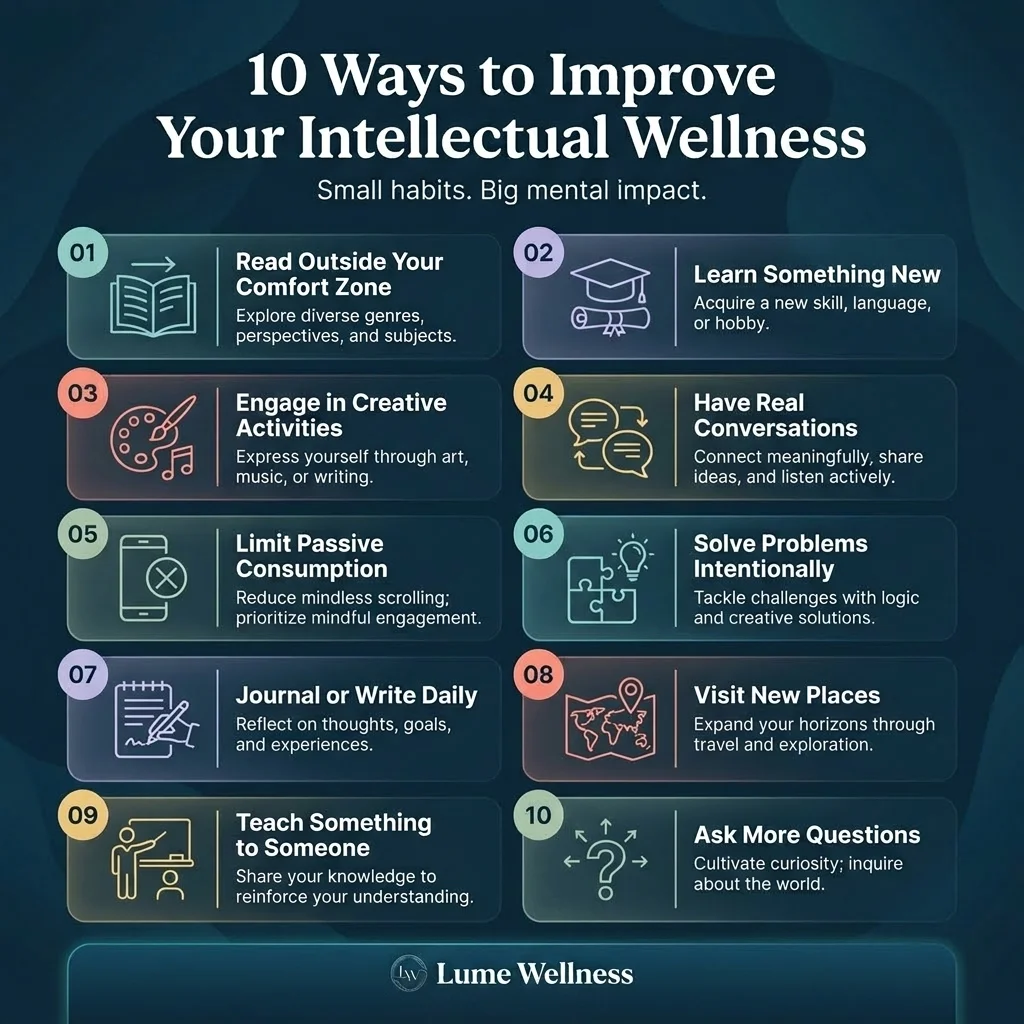
The good news: building intellectual wellness doesn’t require a radical lifestyle change. Small, consistent habits make a significant difference.
- Read outside your comfort zone: Pick up a book in a genre or topic you’d normally skip. Non-fiction, history, science, philosophy even a different style of fiction challenges your brain to process new patterns.
- Learn something new: Take an online course, pick up a language, or try an instrument. The process of learning itself, not mastery is what builds cognitive reserve.
- Engage in creative activities: Painting, cooking, writing, photography, woodworking — creativity engages different neural networks than analytical work and is deeply restorative.
- Have real conversations: Deep conversations with people who think differently than you do are one of the most underrated forms of mental stimulation.
- Limit passive consumption: Scrolling social media or binge-watching TV are not intellectual wellness activities. They occupy your attention without stimulating your mind. Balance them with active engagement.
- Solve problems intentionally: Puzzles, crosswords, strategy games, or even tackling a home improvement project — problem-solving keeps your brain sharp.
- Journal or write: Writing forces you to organize and articulate your thinking. Even 10 minutes of journaling per day exercises critical and reflective thinking.
- Visit new places: Travel even locally exposes your brain to new stimuli, forcing it to adapt and engage. Explore a new part of Peoria, visit a museum, or take a different route.
- Teach something to someone: Teaching requires you to organize and articulate knowledge at a deeper level than just reading it. Find opportunities to share what you know.
- Ask more questions: Curiosity is a practice, not just a trait. Make a habit of asking “why” and “how” about things you encounter every day.
Intellectual Wellness Is Part of Your Whole-Body Health
True wellness isn’t just physical. The eight dimensions of wellness — physical, emotional, social, intellectual, spiritual, environmental, occupational, and financial all connect and influence each other.
When your intellectual wellness is low, your emotional health suffers. When your hormones are imbalanced, your cognitive function suffers. When your gut health is poor, your mood and mental clarity suffer. Everything is connected.